His training
An Orthopedic Sports Medicine Surgeon trains first as an Orthopedic Surgeon, then completes a fellowship in sports injuries. Dr. Pharr did his at the American Sports Medicine Institute in Birmingham, the Sports Medicine fellowship founded by Dr. James Andrews. He’s board-certified by the American Board of Orthopaedic Surgery in Orthopaedic Surgery, with a subspecialty certificate in Orthopaedic Sports Medicine.
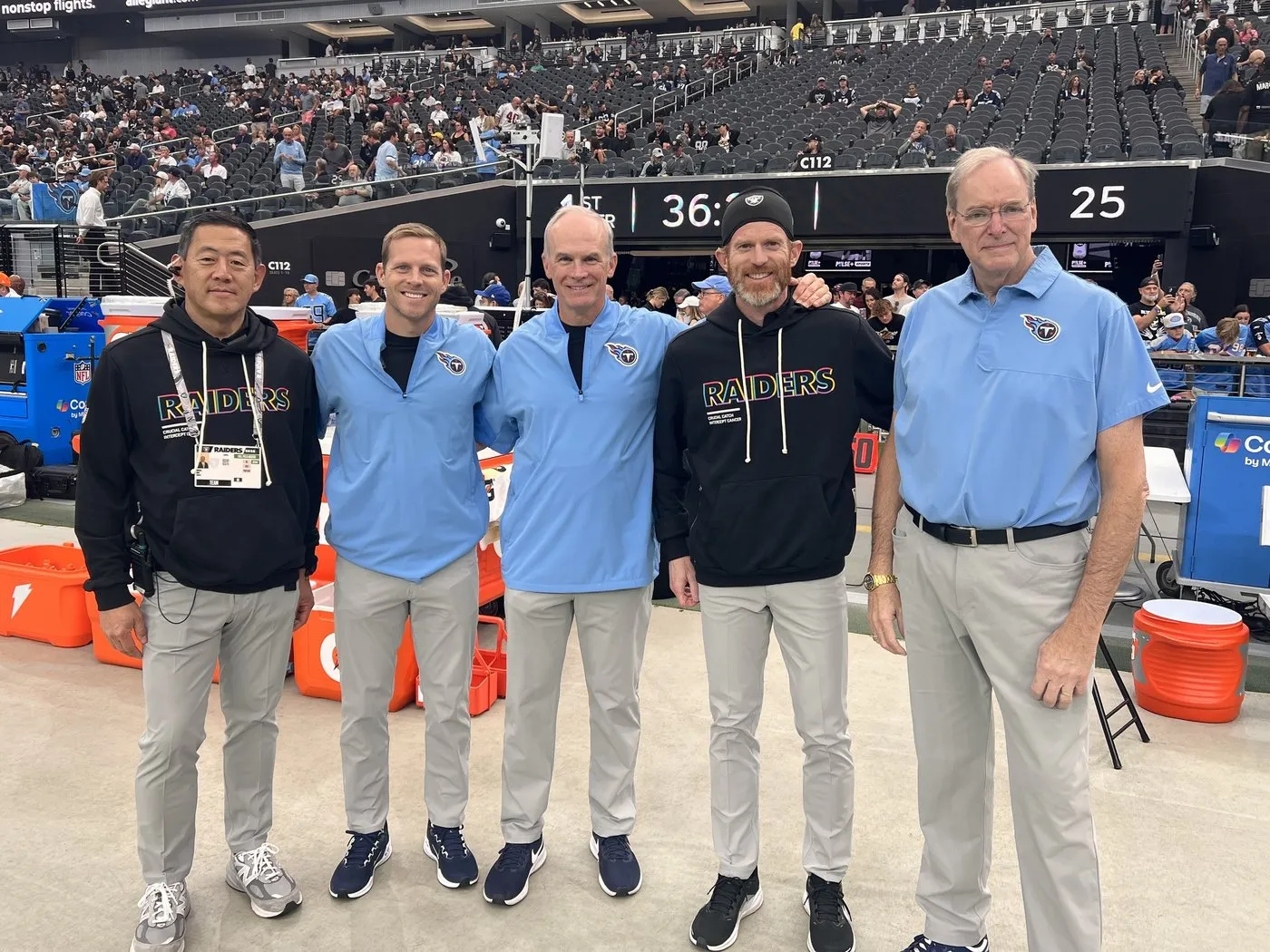
He’s also a Team Physician for the Tennessee Titans and a Team Physician for schools and teams across Middle Tennessee, so he sees athletes on the sideline as well as in the office.
Who he treats
Athletes from youth leagues to the pros, and weekend warriors too: the runners, cyclists, and pickleball players whose knee, hip, or shoulder has started to get in the way.
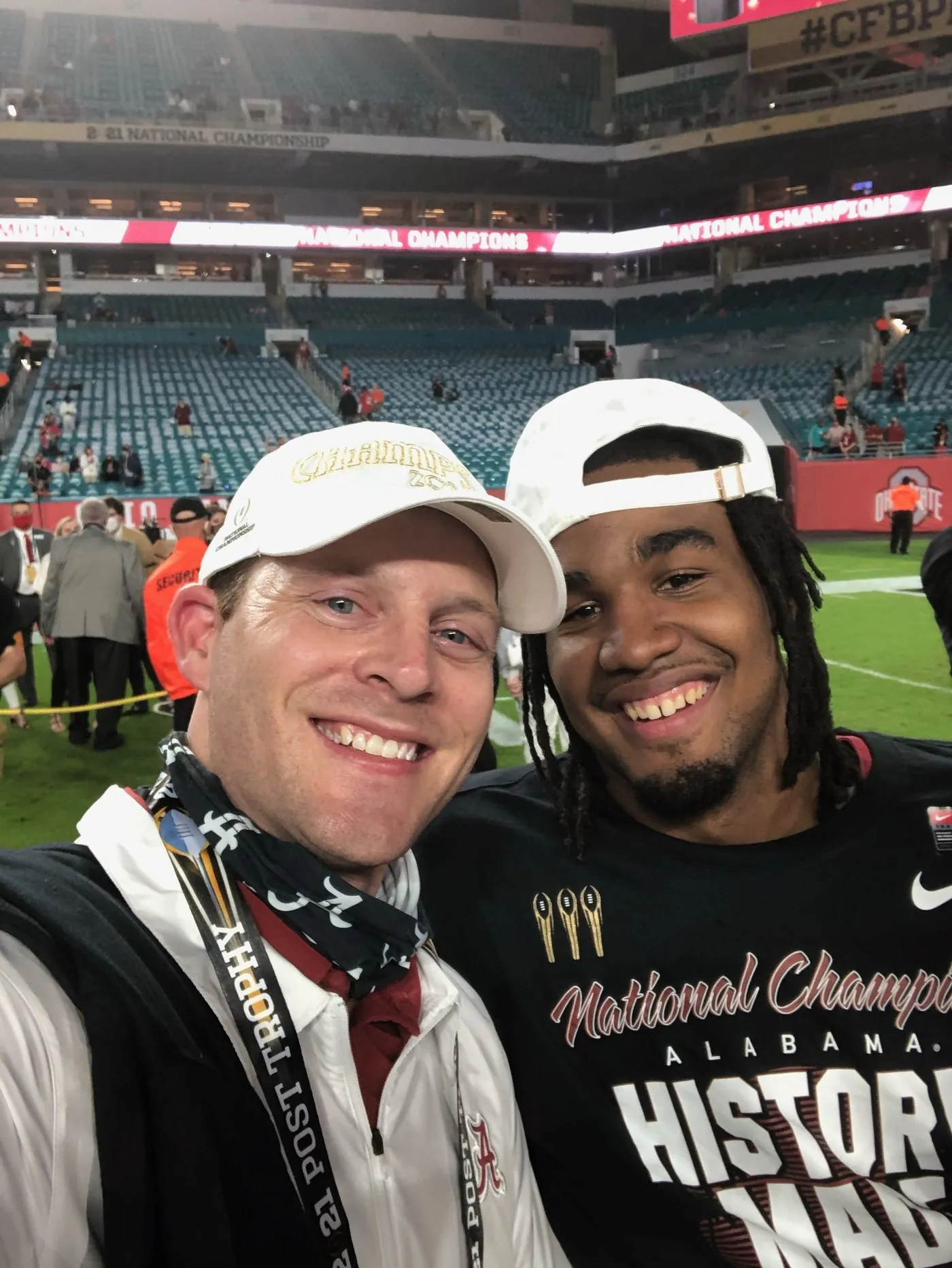
Dr. Pharr on the field with an Alabama player after the 2021 national championship game, during his fellowship year.
What he treats
Most sports injuries are to a joint and the soft tissue around it: ligaments, tendons, cartilage, and the labrum, the ring of cartilage around the rim of the shoulder and hip sockets.
- Shoulder. Instability and dislocations, labral tears, rotator cuff tears, and throwing-shoulder injuries.
- Elbow. Throwing injuries of the UCL, including UCL repair and Tommy John reconstruction.
- Hip. Labral tears and hip impingement, where the ball and socket don’t fit well, including hip arthroscopy. More on hip pain.
- Knee. ACL tears and ACL surgery, meniscus tears, cartilage injuries, and a kneecap that slips out of place. More on knee injuries.
- Injections. PRP, where it fits.
How he decides about surgery
He starts with the person. “I really try to dig into what that patient enjoys, what gives them drive, what their goals are,” he says.
For athletes, the season matters as much as the injury, so he plans around your whole year. That can mean getting through the season with bracing, rehab, and maybe a PRP injection, or it can mean surgery now, so there’s time to recover before the season that matters most.
He doesn’t jump to surgery. Surgery has real risks and doesn’t always work, and treatment without surgery may not heal every injury, so he goes through both with you before you decide.
Where
He sees patients at Tennessee Orthopaedic Alliance in Spring Hill and Columbia, and patients come to him from across Middle Tennessee.