On the court himself
Dr. Pharr grew up competing in every sport he could and played Division I golf at Lipscomb University. These days a lot of that competitiveness goes into pickleball. He plays multiple times a week with friends and colleagues, and in tournaments around Nashville.
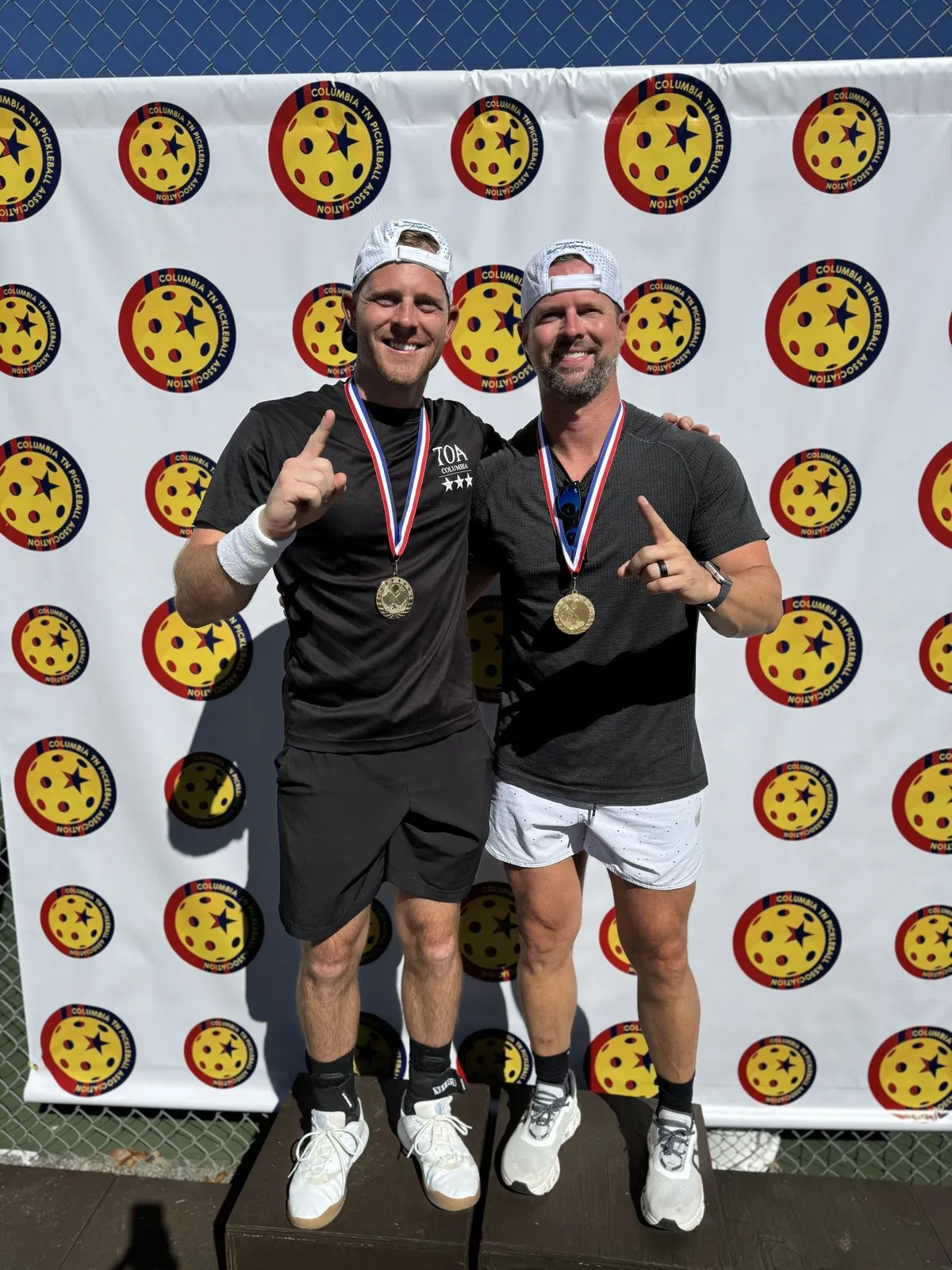
Dr. Pharr (left) and his doubles partner, Dr. Cason Shirley of Tennessee Orthopaedic Alliance, with their medals at a Columbia TN Pickleball Association championship.
Knee
A knee that pops now and then, with no injury, is often normal. A pop during a quick lunge or pivot, with pain and swelling, is different and deserves an exam, since it can be a ligament, the meniscus, or the cartilage. A knee that gives out can be quadriceps weakness or a kneecap that doesn’t track well in its groove, and sometimes ligament damage. The knee injury page goes into each.
The meniscus is the knee’s shock absorber, and a tear can feel like a sharp, stabbing pain, a catch, or a dull ache. Not every tear needs surgery, but a torn piece that catches or locks the knee is a different situation. See meniscus tears.
Shoulder
A rotator cuff tear often feels like a sharp pain when you reach out for a ball, or a dull ache that grows over time. Unless it’s a complete tear that has pulled back, many get better without surgery, with physical therapy built around the tear.
Elbow
Players call pain on the outside of the elbow “pickleball elbow.” It’s the same overuse injury as tennis elbow, and most people get better without surgery, according to the American Academy of Orthopaedic Surgeons. Treatment options include rest, medication, physical therapy, a brace, steroid injections, shock wave therapy, and a check of your equipment. For some tendon injuries, PRP is another option Dr. Pharr talks through.
Hip
A hip labral tear feels like a sharp pain in the hip with bending and squatting, like getting low for a dink, and while it’s still causing pain, deep squats tend to aggravate it. Some people are built with a hip that fits more like a square peg in a round hole, which can damage the labrum. That’s hip impingement, and the hip pain page explains both.
Staying on the court
The American Academy of Orthopaedic Surgeons has five simple pickleball injury prevention tips: take lessons, wear the right shoes, warm up, stay hydrated, and know your limits.